Separate what a supplier claimed from what actually arrived.
← All projects
Operations / Independent productLive · private application
CustomerReturned.
Know what a return is really worth.
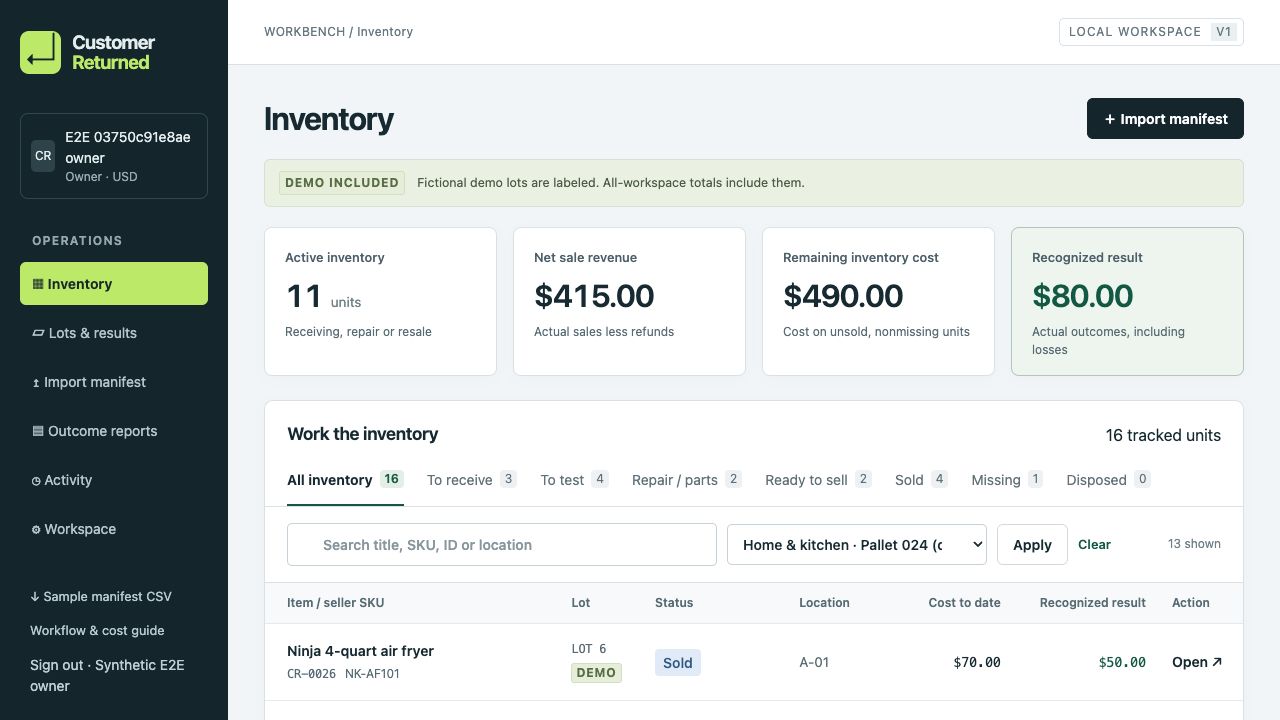
CustomerReturned is built around the messy reality of returned inventory: missing units, repairs, parts, fees, refunds, and the difference between a seller’s claim and what arrived.
The challenge
A manifest is a claim, not an inventory count. Reliable decisions require physical reconciliation and costs that follow each unit through every change in its story.
The approach
The workbench connects receiving, inspection, repair, sales, and returns with integer-cent cost allocation, private photos, role boundaries, and an activity history.
Current availabilityA private operations application. Marketplace integrations and payment processing are outside this release.
WHAT THE WORK ENABLESBuilt around
Built around
the useful details.
Specific capabilities, connected to
the people doing the work.
Keep acquisition, repair, sale, and return costs with the inventory.
Give the team a shared record of each unit’s condition and progress.
THE EXPERIENCEFrom the first step
From the first step
to the next one.
- 01
Receive
Import a manifest, reconcile delivered units, and record discrepancies.
- 02
Work the stock
Inspect items, record repairs, attach private photos, and follow their status.
- 03
Close the loop
Record sales and returns with allocated costs and an activity history.
THE BUILD INCLUDES
- Manifest import and receiving workbench
- Unit-level costs and lifecycle records
- QR labels, private media, roles, and history
LOOK UNDER THE HOOD
Interested in how it works?
Matthew’s developer portfolio covers the implementation, shared packages, and source examples behind this project.
Explore the engineering ↗